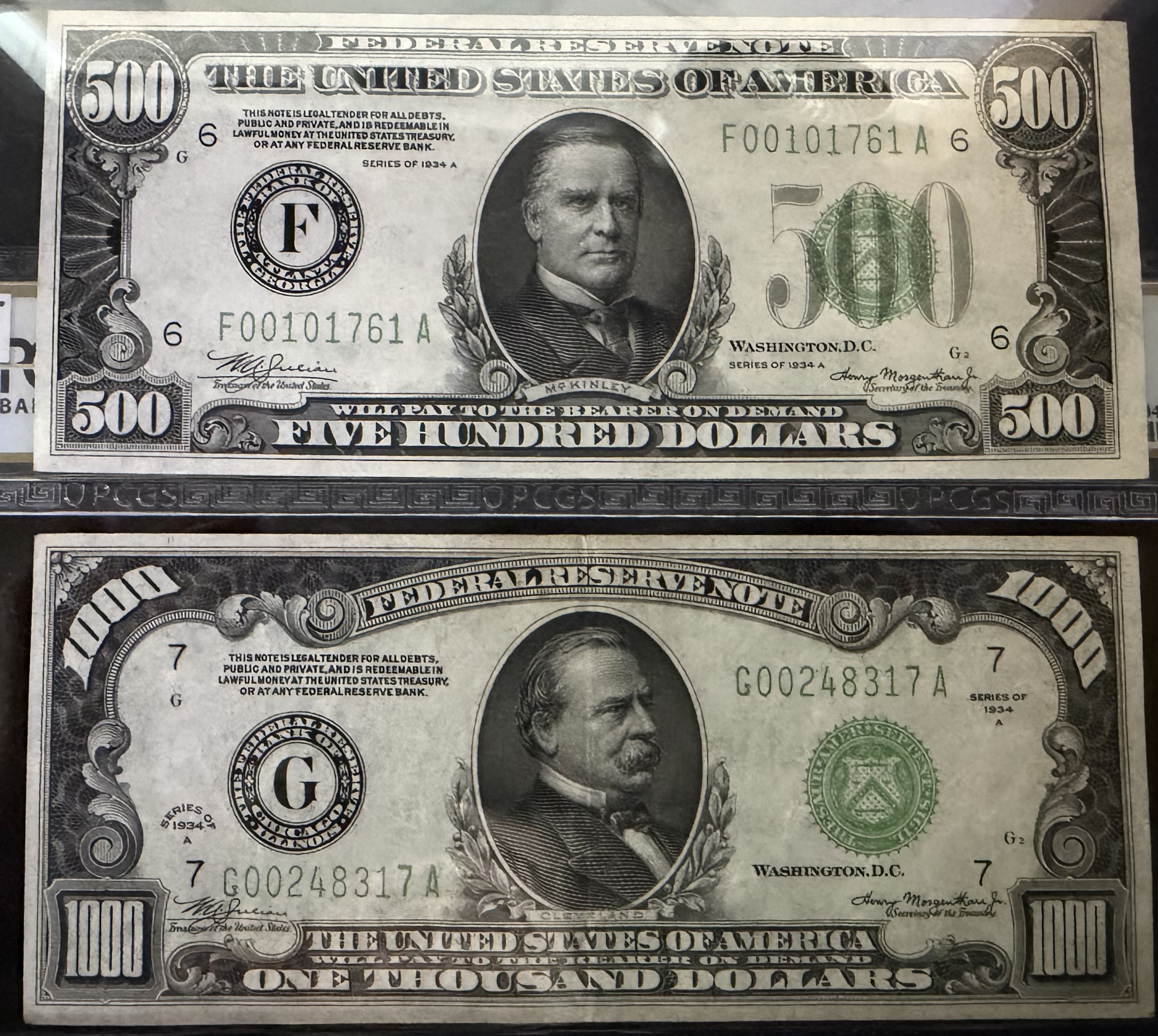
If you've come across a $500 or $1,000 bill — tucked away in an old wallet, found in a safe, or inherited as part of an estate — you're holding something genuinely rare. These high denomination notes were once a normal part of American commerce. Today they are collectibles, and in many cases worth significantly more than their face value.
Here's everything you need to know.
A Brief History of High Denomination Currency
The United States issued currency in denominations far beyond what most people see today. In addition to the $500 and $1,000, the government also printed $5,000 and $10,000 notes — and even a $100,000 gold certificate, though that one never circulated publicly.
High denomination bills were primarily used for large transactions between banks and financial institutions. Before wire transfers and electronic payments, moving large sums of money required physical currency, and these notes made that practical.
The Federal Reserve began pulling high denomination bills from circulation in 1969 under President Nixon. The official reason was that electronic banking had made them unnecessary. Once a bill was returned to a Federal Reserve Bank, it was destroyed rather than recirculated. That process has been ongoing for over 50 years — which is exactly why surviving examples are so scarce today.
The $500 Bill
The most commonly encountered high denomination note, the $500 bill features a portrait of William McKinley, the 25th President of the United States.
Several series were issued over the decades, including:
- 1928 Series — Small-size Federal Reserve Notes
- 1934 Series — The most commonly seen $500 bills today
- 1934A, 1934B, 1934C — Later printings with subtle differences
What Is a $500 Bill Worth?
A circulated $500 bill in average condition typically sells for $600 to $2,700 or more, depending on the series, Federal Reserve district, and condition. Uncirculated examples in top grades can bring $3,000 to $10,000+.
Certain Federal Reserve districts printed far fewer notes than others. A $500 bill from a low-mintage district — such as Minneapolis or Kansas City — can command a substantial premium over a more common district like New York or Chicago.
Star notes (replacement notes indicated by a star symbol in the serial number) are especially scarce and valuable.
The $1,000 Bill
The $1,000 bill features Grover Cleveland, the only U.S. President to serve two non-consecutive terms (22nd and 24th). Like the $500, it was issued in the 1928 and 1934 series.
What Is a $1,000 Bill Worth?
A circulated $1,000 bill in average condition typically sells for $1,200 to $4,000+. High-grade uncirculated examples regularly bring $5,000 to $25,000 or more. Rare district issues and star notes push values even higher.
The $1,000 bill is rarer than the $500 — fewer were printed, and fewer survived. If you have one, it deserves a careful evaluation.
What Makes a High Denomination Bill More Valuable?
Not all $500 or $1,000 bills are equal. Several factors drive value:
1. Condition (Grade)
Condition is the single biggest factor. A crisp, uncirculated note is worth multiples of a heavily worn example. Professional grading by PCGS (Professional Coin Grading Service) and PMG (Paper Money Guaranty) — are the gold standard for currency certification — protects your note, authenticates it, and assigns an objective grade that buyers trust.At Clemson Coins, we are vetted PCGS and PMG members and can help you understand what your note might grade before you decide to submit it.
2. Federal Reserve District
Each bill was printed for one of twelve Federal Reserve districts. Some districts issued far fewer notes. Low-mintage districts carry a premium — sometimes a significant one.3. Serial Number
- Star notes (replacement notes with a ★ in the serial number) are scarcer and more desirable
- Low serial numbers (especially 1 through 100) attract collector premiums
- Solid serials (all the same digit) and radar notes (serial reads the same forward and backward) are novelty collectibles
4. Series Year
The 1928 series is generally scarcer than 1934. Within the 1934 series, later printings (1934A, B, C) vary in rarity by district.5. Signatures
Different Treasury Secretary and Register of the Treasury signature combinations correspond to different printings. Some combinations are rarer than others.Should You Get Your Bill Graded?
If your bill is in very fine or better condition, professional grading by PCGS or PMG is almost always worth considering. A PCGS or PMG-graded note:
- Is authenticated and guaranteed genuine
- Has an objective, trusted grade that buyers rely on
- Is sealed in a tamper-evident holder that protects it
- Typically sells for more than a raw (ungraded) note of the same quality
Common Questions
Is it legal to own a $500 or $1,000 bill?
Absolutely. High denomination bills are legal to own, buy, and sell. They remain legal tender at face value, though no one spends them — they are worth far more as collectibles.Can I spend a $500 bill?
Technically yes — it is still legal tender. But spending a $500 bill for $500 worth of goods when it may be worth $1,000 or more as a collectible would be a costly mistake. Have it evaluated first.How do I know if my bill is genuine?
Counterfeiting high denomination bills is rare but not unheard of. Professional grading by PCGS or PMG is the definitive answer. We also examine currency with our expertise and can spot obvious issues before you invest in grading.What about $5,000 and $10,000 bills?
These exist and are extraordinarily rare. If you have one, it is a significant find. Values for $5,000 bills start in the tens of thousands of dollars to over one hundred thousand dollars. $10,000 bills are museum-quality rarities and sell for multiple hundred thousand dollars. Contact us immediately if you believe you have one.We Buy High Denomination Currency
At Clemson Coins, Currency and Bullion in Pendleton, SC, we buy all high denomination currency — $500 bills, $1,000 bills, and rarer denominations. As vetted PCGS and PMG members, we understand certified currency values at the highest level and pay accordingly.
We serve collectors and sellers across Upstate South Carolina, Western North Carolina, Northeast Georgia, and Eastern Tennessee. Our 450+ five-star Google reviews reflect what sellers already know: we pay more, and we do it honestly.
Get your best offer anywhere else first — then bring it to us. We'll beat it.
Walk in Tuesday through Saturday, 10am–5pm, at our Pendleton, SC location. For large collections or if you're traveling a significant distance, call ahead at 864-502-0100 so we can ensure the right person is available for you.