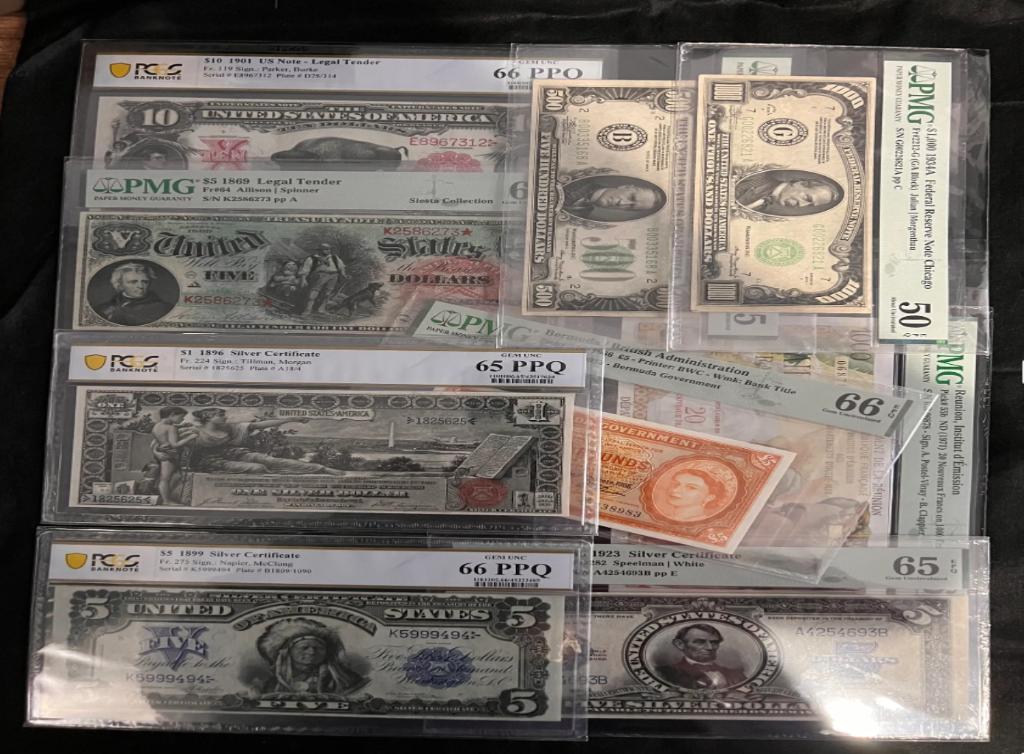
You found a stack of old bills in a drawer, a safe, or an estate. Maybe they are from the early 1900s, maybe they are silver certificates, maybe they are just unusual-looking notes you have never seen before. The question is simple: are they worth anything?
The answer, more often than you might think, is yes — sometimes a lot more than face value.
At Clemson Coins, Currency and Bullion in Pendleton, South Carolina, we buy all types of paper currency from collectors, estates, and everyday sellers across Greenville, Anderson, Clemson, Spartanburg, and the entire Upstate. Here is what you need to know before you sell.
What Types of Paper Currency Do We Buy?
We purchase virtually every type of United States paper currency, including raw, certified PCGS, NGC, Legacy & CGA:
- Large-size notes (pre-1929) — These oversized bills are highly collectible and often worth significant premiums over face value
- Silver Certificates — Blue seal notes from the 1800s through 1957 that were once redeemable for silver
- Gold Certificates — Yellow seal notes backed by gold, now rare and collectible
- Federal Reserve Notes — Including older series with collectible value
- National Bank Notes — Issued by individual banks across the country, these are especially sought after by regional collectors
- Confederate Currency — Civil War-era Confederate States of America notes
- Fractional Currency — Small denomination notes issued during the Civil War era
- Star Notes — Replacement notes identified by a star symbol in the serial number
- Error Notes — Misprints, double prints, ink smears, and other production errors
- Low Serial Number Notes — Bills with serial numbers like 00000001 through 00000100
- Fancy Serial Numbers — Repeaters, radars, ladders, and solid serial numbers
- High-Grade Circulated and Uncirculated Notes — Condition matters enormously in paper currency
How Is Paper Currency Valued?
Paper currency valuation is more nuanced than coins or bullion because there is no melt value — it is entirely about collector demand, rarity, and condition.
The key factors that determine what your notes are worth:
1. Type and Series
A 1899 Black Eagle Silver Certificate in fine condition is worth hundreds of dollars. A 1957 Silver Certificate in the same condition might be worth a few dollars over face value. The type and series year matter enormously.
2. Condition (Grade)
Paper currency is graded on a scale from Poor (1) to Gem Uncirculated (70). A note in Extremely Fine (EF-40) condition can be worth ten times what the same note in Good (G-4) condition brings. Folds, tears, stains, and writing all reduce value significantly.
3. Rarity
Some notes were printed in very small quantities. National Bank Notes from small towns, certain series dates, and specific Federal Reserve districts can be extremely rare. A note that looks ordinary might be worth thousands simply because very few examples survive.
4. Serial Number Appeal
Collectors pay premiums for notes with interesting serial numbers:
- Low serials (00000001–00000100) — highly desirable
- Solid serials (11111111, 22222222) — very collectible
- Radar notes (12344321) — reads the same forwards and backwards
- Ladder notes (12345678) — sequential digits
- Repeater notes (12341234) — repeating pattern
- Star notes — replacement notes with a ★ in the serial
5. Signatures
U.S. currency is signed by the Treasurer and Secretary of the Treasury. Certain signature combinations are rarer than others and command premiums.
What About Confederate Currency?
Confederate States of America notes are actively collected and can range from a few dollars to several thousand depending on the type, date, and condition. Early issues from 1861 are generally more valuable than the later high-inflation issues from 1864. Condition and authenticity are critical — reproductions exist and are worth nothing to collectors.
What About Foreign Currency?
We buy world banknotes as well. Older issues from Germany (including Weimar-era hyperinflation notes), pre-revolutionary China, Imperial Russia, and many other countries have strong collector markets. Modern foreign currency at face value is generally not collectible, but older issues can surprise you.
Should You Get Your Notes Graded First?
For notes potentially worth $500 or more, professional grading by PMG (Paper Money Guaranty) and PCGS (Professional Coin Grading Service) can significantly increase value and buyer confidence. At Clemson Coins Currency and Bullion, we are PMG & PCGS Authorized Members and can advise you on whether grading makes sense for your specific notes.
For most everyday currency — silver certificates, older Federal Reserve notes, and common large-size notes — grading is sometimes not necessary to get a fair offer.
What to Avoid When Selling Paper Currency
Online auction sites can work for common notes, but rare or high-value currency often sells below its true market value when sellers do not know what they have.
Pawn shops typically do not specialize in paper currency and will offer generic prices that do not reflect collector premiums.
Mail-in buyers — sending irreplaceable notes through the mail to an unknown buyer is a risk not worth taking.
Selling without research — even a quick look at a price guide or a conversation with a specialist can make a significant difference in what you receive.
Why Sell to Clemson Coins?
We have been buying and selling paper currency for decades. We know the difference between a common 1957 Silver Certificate and a rare 1899 Educational Series note. We know which National Bank Notes command collector premiums and which serial numbers attract serious buyers.
When you bring your currency to us:
- We examine every note carefully under proper lighting
- We identify the series, signatures, and any special characteristics
- We check or know current dealer and auction market data
- We make you a fair, transparent offer based on actual collector value — not just face value
As always — get your best offer elsewhere first, then come see us last. We want to pay you more.
Bring Your Paper Currency to Clemson Coins
Located in Pendleton, South Carolina — just minutes from Greenville, Anderson, Clemson, Easley, and all of Upstate SC — we are ready to evaluate your paper currency at no charge and with no obligation.
Walk in any time during business hours. No appointment needed.
Clemson Coins, Currency and Bullion Pendleton, South Carolina
We Pay More, Always.