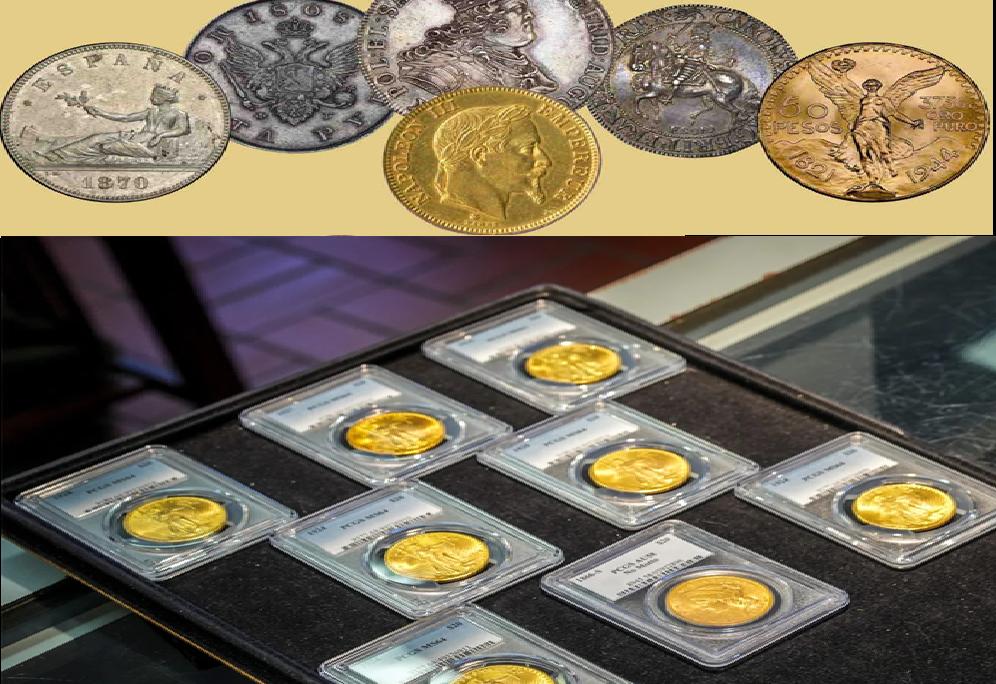
If you have a coin collection — whether inherited, accumulated over decades, or purchased as an investment — one of the most important things to understand is the difference between ungraded coins, professionally graded coins, and key date coins. The difference between these categories can be the difference between a coin worth face value and one worth thousands of dollars.
At Clemson Coins, Currency and Bullion in Pendleton, South Carolina, we buy all three. Here is what you need to know.
Ungraded (Raw) Coins
An ungraded coin — also called a "raw" coin — is any coin that has not been submitted to a professional third-party grading service. It sits loose in a flip, a 2x2 cardboard holder, an album, or just rattling around in a box.
Raw coins are not necessarily low-value coins. Many raw coins are extremely valuable. The term simply means the coin has not been independently authenticated and graded by a service like PCGS, NGC, CACG, ANACS or ICG.
What affects the value of a raw coin?
- Date and mint mark — some dates are dramatically rarer than others
- Condition — the better the coin looks, the more it is worth
- Eye appeal — luster, strike quality, and originality of surfaces matter
- Series — Gold Liberty, Gold Indians, Gold St. Gaudens, Trade Dollars, Morgan Dollars, Barber Coinage, Standing or Seated Coinage, Walking Liberty Halves, Buffalo Nickels, Indian Head Pennies and many other series have strong collector demand
When necessary, we use our experience, XRF and Sigma Metalytics, calibrated scale and Mitutoyo calipers testing equipment to verify the authenticity and metal content of every raw coin we evaluate — at no charge to you.
Professionally Graded Coins
A professionally graded coin has been submitted to an independent third-party grading service — most commonly PCGS (Professional Coin Grading Service), NGC (Numismatic Guaranty Company), or CACG (Certified Acceptance Corporation Grading) — and encapsulated in a tamper-evident plastic holder called a "slab."
The slab displays:
- The coin's grade on the standard 70-point Sheldon scale (1 = barely identifiable, 70 = perfect)
- The certification number for verification
- Any special designations (Deep Mirror Prooflike, Full Steps, Full Bands, Cameo, Ultra Cameo, etc.)
- A CAC sticker if the coin has been approved by the Certified Acceptance Corporation as a premium-quality example for its grade
Because the grade determines the value — dramatically. Consider a 1921 Morgan Dollar:
- In circulated condition (VF20): worth barely silver melt
- In MS63: worth $50–$100
- In MS65: worth $150-$200
- In MS66: worth $500-$800
- In MS67: worth $5,000–$10,000+
For key dates and semi-key dates, the spread is even more dramatic. A 1916-D Mercury Dime in G4 is worth around $1,000. The same coin in MS65 is worth $30,000 or more.
PCGS, NGC, and CACG grading can significantly increase the value of your coins. We are PCGS, NGC, and CACG authorized dealers and can advise you on whether submitting your coins for grading makes financial sense before you spend money on submission fees.
Key Date Coins
A key date is a coin from a particular series that had an unusually low mintage, was heavily circulated and melted, or for some other reason survived in far fewer numbers than other dates in the same series. Key dates are the coins that collectors need most — and are willing to pay the most to acquire.
Key Dates by Popular Series
Morgan Dollars (1878–1921)
- 1893-S — the king of Morgan Dollars; worth $5,000+ even in heavily worn condition
- 1895 — proof only; no business strike known; extremely rare
- 1889-CC, 1892-CC, 1893-CC — Carson City key dates
- 1901 — low mintage Philadelphia issue
- 1916-S — first year, low mintage
- 1921, 1921-D — extremely low mintage; key dates of the series
- 1938-D — final year, low mintage
- 1916-D — the key date; worth $1,000+ even worn
- 1921, 1921-D — low mintage depression-era issues
- 1942/41 overdate — rare error coin
- 1913-S Type 2 — first year variety
- 1916 doubled die — rare error
- 1918/7-D overdate — rare overdate variety
- 1926-S — low mintage
- 1937-D 3-Legged — famous error; missing one leg on the buffalo
- 1909-S VDB — the most famous key date in U.S. coinage
- 1909-S — without VDB; also a key date
- 1914-D — major key date
- 1922 plain — no mint mark; rare die variety
- 1931-S — low mintage depression-era issue
- 1955 doubled die — one of the most famous error coins ever produced
How Do You Know If You Have a Key Date?
The honest answer: you may not know without expert evaluation. Many key dates look identical to common dates at first glance. The only difference is a small mint mark — or the absence of one — and the date itself.
This is exactly why you should bring your coins to an expert before selling them anywhere. Get their offer and then come and see us. We have the expertise to identify key dates, varieties, and error coins that other buyers might miss — or might not tell you about. Remember, we pay more, always!
We will never lowball you on a key date. Our reputation is built on honesty, integrity, paying you more (because we like to sleep at night) and that starts with correctly identifying what you have.
What Should You Do Before Selling?
Clemson Coins, Currency and Bullion Pendleton, South Carolina — convenient to Greenville, Anderson, Clemson, Easley, Pickens, Spartanburg, and all of Upstate SC.
Walk in any time. No appointment needed.
We Pay More, Always.